
Dear candidate, will you fix our road safety emergency?
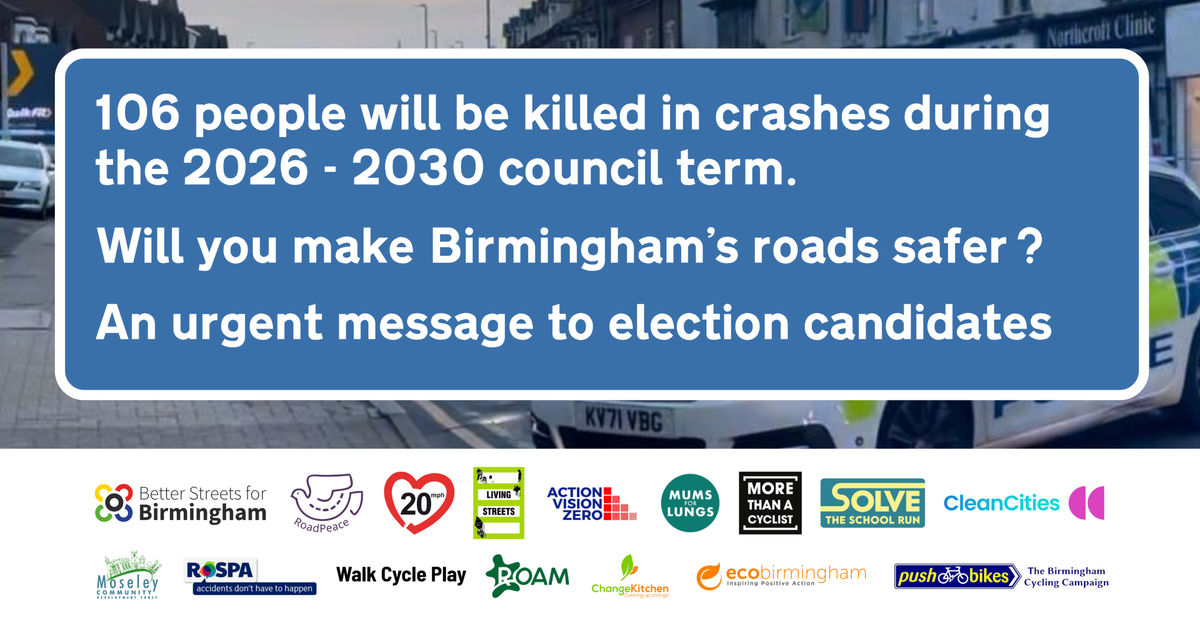
Dear Candidate
Congratulations on deciding to stand in the council elections.
Our city continues to be in a road safety emergency. In the short campaign alone so far, we have already lost several lives and others have been seriously injured. Decisive action in the next council term has the potential to save over 100 lives, as well as preventing thousands of life-changing crashes.
Birmingham City Council also continues to deliver transport projects at snail's pace. Many lose confidence that improvements to their streets and journeys will be improved. This means more people stick to driving, contributing to daily gridlock.
Should you be successful, you will have the opportunity to make change in the city. Change that will help over 1.1 million people get around Birmingham safely and more efficiently.
Locally, you'll be given £150,000 to improve the safety of streets in your ward between 2026 and 2029. There's also hundreds of millions of pounds going into upgrading public transport, cycling and walking in the city.
This is investment that residents repeatedly say is what will help them to leave their car at home for some trips.
Better Streets for Birmingham is a Community Interest Company that has been highlighting the need for better transport infrastructure across the city and the danger that road safety poses to residents.
We have engaged with communities across the city. No matter whether they're bereaved family of a road traffic collision, getting caught in congestion on their way to work, dodging potholes, stuck waiting for buses that don't show up, are scared for their children to cycle to school, or are plainly unable to use the pavement as they're full of parked vehicles, everyone agrees that there is an urgent need for change.
This is why we've created a vision, outlined the problem and set out ten steps to address the road safety emergency. You can find these, along with useful information about how transport is funded and works, later on in this message.
We stand ready to work with councillors to help identify the changes needed in their ward.
Good luck with your campaign.
Best wishes,
Martin Price
Chair, Better Streets for Birmingham
Our vision for getting around Birmingham
Imagine a Birmingham where you walk or wheel easily along clear and well-kept pavements. You can pause on a bench for a moment of rest. There are trees to provide shade from the sun and shelter from the rain.
As you move around your community, you cross the street quickly and safely, confident that other people will give way.
Streets are calmer, which has made cycling an everyday option to many. There is a network of safe cycle routes connecting the city. You can park your bike securely in an on-street hangar or hire an e-bike affordably at the end of your street.
Most children walk, scoot or cycle to school, often with family or friends, getting fresh air and exercise to start the day ready for learning. After school, they can play and spend time outside safely, close to home.
For longer trips, your local bus, train or tram is reliable, affordable, frequent and available day and night. They get you to where you need to go on time. You tap your card and get charged the best fare for your day.
When you do need to drive, journeys are smoother and less stressful. Drivers are patient, roads are safer, and running a car costs less. If you don’t own a car, you can easily rent one when you need it.
You can move around your city freely, safely and confidently. You feel healthier, you spend less, and you have more time for the things that matter.
This is a Birmingham with better streets.
The problem
Getting around Birmingham too often means putting yourself at risk. Pavements are obstacle courses and road rules are rarely enforced.
The city has declared a road safety emergency. Someone is killed in a collision every two weeks, and someone is seriously injured every day. Beyond the personal and community tragedy, crashes cost Birmingham £205 million each year.
Every day, 10 million vehicle miles are driven on our streets — creating congestion that costs the city £300 million annually and contributing to 900 early deaths each year from poor air quality. Yet a quarter of car trips are under a mile, journeys that could often be made by walking, wheeling or cycling. With almost one third of Birmingham’s adults and a quarter of 11-year-olds obese, encouraging more people of all ages to walk, wheel or cycle would have a dramatic improvement in their health.
Birmingham features in 8 of the top 15 postcodes for uninsured drivers. Every road policing operation results in car parks full of vehicles confiscated for breaching the rules of the road.
Around a third of children are driven to school. Families often say they’d prefer to walk or cycle, but unsafe roads, dangerous parking, and traffic congestion make that difficult. As a result, the school run adds thousands of car trips each morning, worsening congestion and air quality around school gates.
Car ownership places a heavy burden on families, taking up around 25% of household income. At the same time, one in three Birmingham households has no car, and many who rely on cars do so because the alternatives feel unsafe, unreliable or unavailable.
Public transport faces major challenges. Buses are delayed by congestion, trams serve limited routes, and train timetables are frequently disrupted. Ticketing remains complex. The current network doesn’t meet the needs of our growing and diverse city.
Cycling and walking should be safe and practical choices, but many residents don’t feel protected. Only those using our limited patchwork of separated cycle lanes can travel with confidence — though six in ten people say they would cycle if more safe, direct and lit routes were built. Pedestrian access is frequently impeded by poorly parked vehicles.
In residential areas, speeding from through-traffic has become a major concern. Shortcutting traffic has risen 72% since 2009, often overwhelming local streets and junctions never designed for heavy flow. Outcries and petitions for road safety improvements fill councillor inboxes.
Funding for transport projects exists but delivery remains inconsistent. Progress can be slow and fragmented, leaving many disconnected from essential services, education, and employment.
Birmingham needs a joined-up and consistent approach to transport that puts its citizens’ safety, health, and connectivity at its heart.
What will you do to make our streets safe?
Alongside 15 national and local organisations, we are making ten practical asks of you to address the road safety emergency
- Continue rolling out 20mph across the city to reduce casualties by 25% through signage, focusing on residential streets and local centres.
- Upgrade crossings and cut wait times so that people can cross streets safely and quickly.
- Roll out more school streets and wider journey improvements to make routes safer for children.
- Scale enforcement of the rules of the road by creating a programme of speed, red light, banned turn, box junction, bus lane, red line enforcement. Ensure the Council’s new parking enforcement service works.
- Clear pavements for disabled people, children and those who rely on them by creating a programme of controlled parking zones with residents permits and parking restrictions to define who and where people can park on a street.
- Build a network of cycle lanes and cycle-friendly streets connecting the city using devolved funding.
- Install residential cycle hangars using clean air zone money, targeting areas with terraced housing.
- Make residential streets greener and calmer by planting trees and rain gardens, installing benches, narrowing junctions and preventing shortcutting for the 46% still open to through-traffic. Update the next highways contract so that when repairing, they can make safety improvements.
- Upgrade public transport by working with Transport for West Midlands to upgrade bus lanes, railway stations and new tramways.
- Change parking charges and permits to be based on the vehicle by considering size, weight and emissions.
Resources and guidance for candidates
- Our guide to making sense of Birmingham's transport funding
- Our guide to getting transport things done
- Key documents and links
- Our podcast, over 10 episodes covering all sorts of Birmingham transport topics
After the election, we will be glad to meet with elected councillors to explore how ward-based transport funding can be spent.
Due to the number of candidates and the fact we are currently a volunteer-led organisation, we are unable to meet with people beforehand.
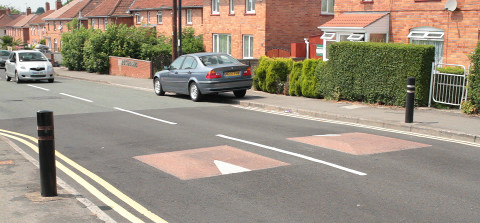
Speed cushions aren't working
- More people are buying wider SUVs
- Normal car models are getting wider every year
- Dangerous to those cycling and motorbiking
- Discouraged in current guidance
- Against council policy
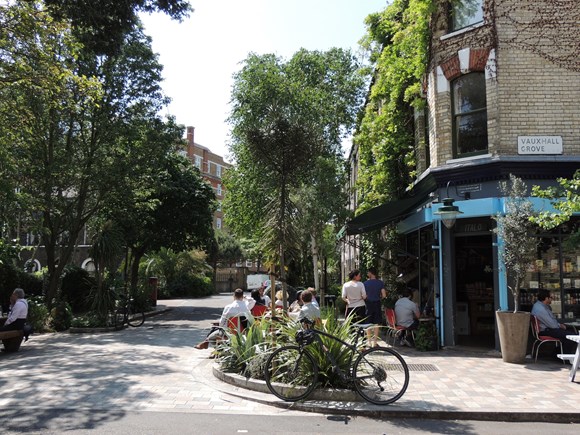
Demand the alternatives
- Re-route through-traffic to the main road
- Remove centre lines
- Narrow the carriageway:
- Mark parking areas
- Extend pavements
- Tighten junction corners (radii)
- Build continuous side road crossings
- Install light separation cycle lanes
- Install place gateways
- Plant trees
- Interrupt sight lines on long roads:
- Alternate parking on the left and right sides of the road
- Install crossing points
- Install mini roundabouts at crossroads
106 people will be killed in crashes during the next council term. Will you make Birmingham’s roads safer?
Speed cushion image from TrafficChoices.co.uk. Healthy Streets image from TfL.