Safer School Journeys Phase 2 Consultation Response
We are responding today to a series of consultations on measures proposed by Birmingham City Council to make streets around schools safer, healthier and more welcoming for pupils, families and the wider community.
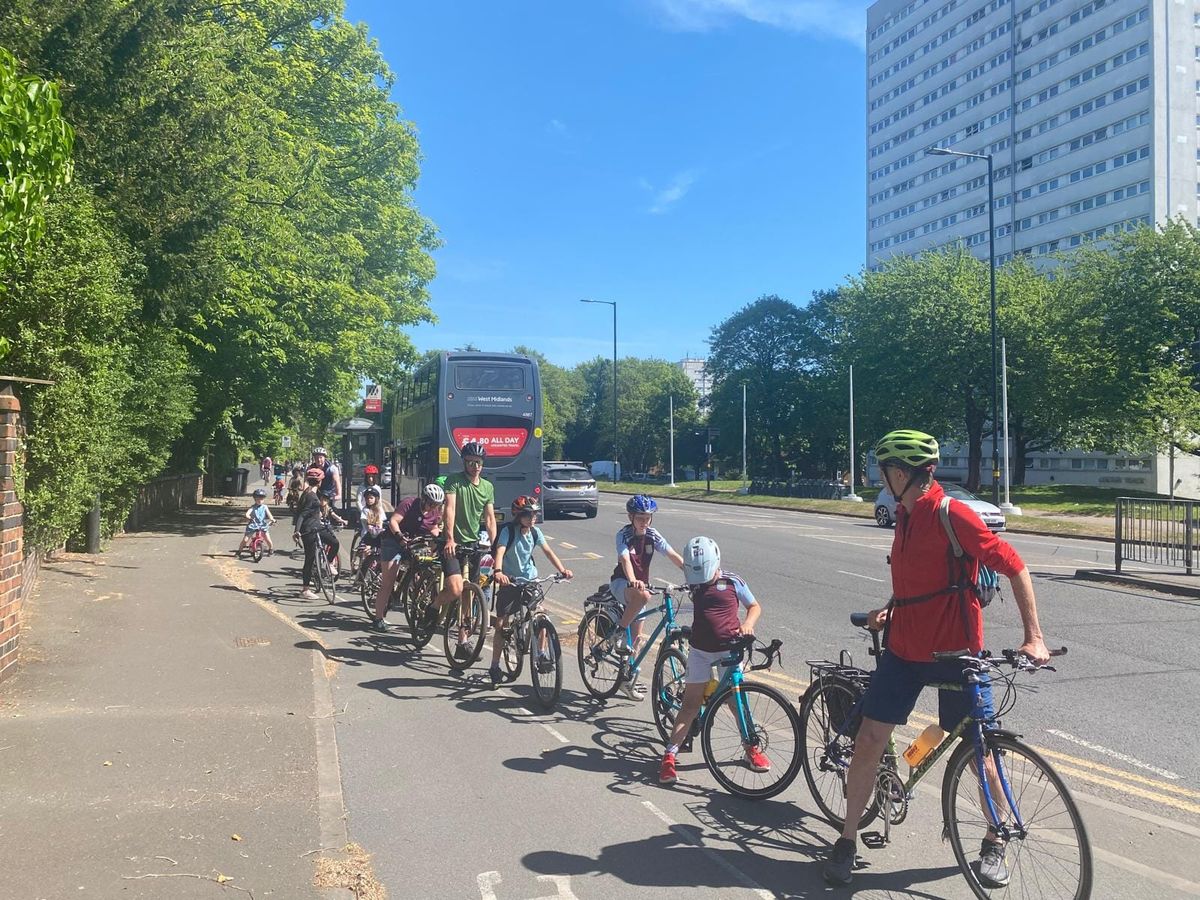
‘The main function of local streets is as places where people live. In recognition of this, motor vehicles (with the key exception of public transport) will be actively deprioritised, with measures installed to remove them wherever possible.’ - BCC Road Harm Reduction Strategy, p27.
We are responding today to a series of consultations on measures proposed by Birmingham City Council to make streets around schools safer, healthier and more welcoming for pupils, families and the wider community.
We are completely in favour of making the streets around schools safer, indeed we believe it to be one of the most important aims of the road safety campaign. We support the council in their mission here. School streets, and the areas around them, should be free of traffic where possible, with safe crossings and wide pavements minimising road danger.
Unfortunately, the quality of the proposals under review varies. Whilst we offer qualified support to some schemes, other schemes we do not support, as we do not believe they will be effective in reducing road danger. In some schemes we are still seeing too many legacy measures, such as one way streets, new coats of paint and dragon's teeth, none of which are proven to reduce KSIs. Indeed, academic research shows one way streets can have a negative affect on residential streets:
‘Rather, one-way streets may encourage higher travel speeds, which are not desirable in residential areas. They create unexpected patterns of vehicle movement, which may be hazardous to pedestrians…In addition the paucity of enforcement in residential areas may encourage unlawful and dangerous driving in the wrong direction on one-way streets.’ (Hocherman et al, 1990)
We urge the council to move on from what we would deem ineffective interventions, and boldly meet the Road Safety Emergency with full implementation of the Road Harm Reduction Strategy. We would also encourage the council to reconsider the strategy of the Safer School Journeys programme. It seems that more schools have been chosen to receive less ambitious schemes, which in many cases we do not believe will make a significant difference. Would it not be more effective to focus resources on ambitious schemes around fewer schools, that will transform how kids can walk, wheel and cycle in the area?
Below we leave constructive feedback for each scheme and indicate our support or opposition.
https://www.birminghambeheard.org.uk/bcc/ssj-stbenedicts/
We cannot support these proposals as we do not believe they will be effective in reducing road harm around the school. The conversion of roads to one way only is shown to increase vehicle speeds, something we do not want to encourage right by the school gates. One way streets also do nothing to reduce the amount of vehicular traffic around the school, which is the most effective way to increase safety. Furthermore, features such as coloured road surfacing puts the trust in the hands of drivers to behave responsibly in this area. Birmingham is still in a declared Road Safety Emergency - that is not a risk we can take.
Instead, through traffic must be removed from the roads on either side of the school, and the use of cars to drop kids off must be discouraged. This can be achieved by two modal filters placed at the junctions with Coventry Road. Instead of a one way system that lays on a plate a route round the school for vehicles, these filters, with two way running on the roads, would heavily discourage attempting to drive down them to drop off your child. If needed in the future, a school street could be set up at the other end of the two roads to further remove traffic around the school.
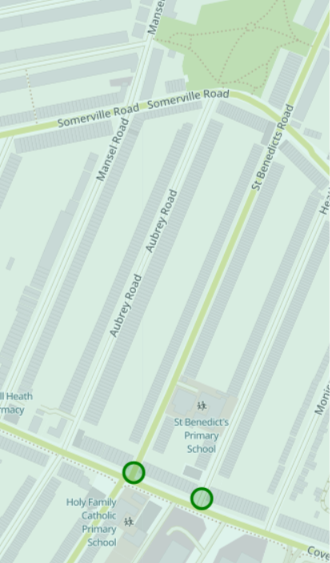
If the original plans do go ahead, then we would ask that the one way exits on Heather/Coventry, and St Benedicts/Somerville junctions, be narrowed to make room for only one vehicle to pass through.
https://www.birminghambeheard.org.uk/bcc/ssj-regentspark/
We support some of the proposals in this scheme, such as the junction narrowing, the bollarding of key junctions, and particularly welcome the full pedestrianisation of a section of Camelot Way by Sara Park.
However, we would like this scheme to be more ambitious and for the interventions to cover a greater area around the school. For example, the junction of Arthur Street and Coventry Road is a KSI hotspot, with a particular issue with drivers making banned right turns. Drivers also use it as a rat run to get to Jenkins Street. There is no reason for this road to remain open as a rat run. The bus stops are not in use. Full pedestrianisation, with access retained for the business at the junction with Bolton Road, would improve safety at the Coventry Road junction, and remove through traffic in the area that kids are walking to the school.
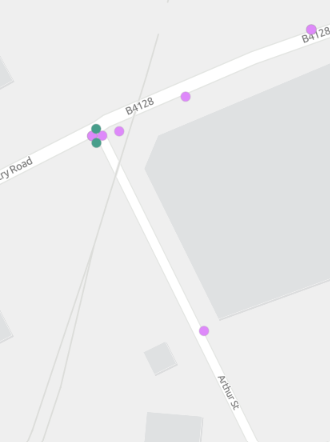
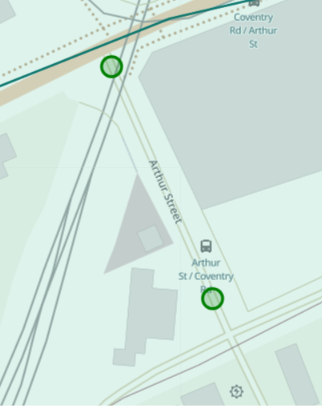
We urge the council to be even bolder in pedestrianising other areas of road around the school. On the other side of Sara Park, the section of Herbert Road marked out below has no access needs for properties, and should be reclaimed for people. This would further enhance the safety of kids walking to the school from this direction.
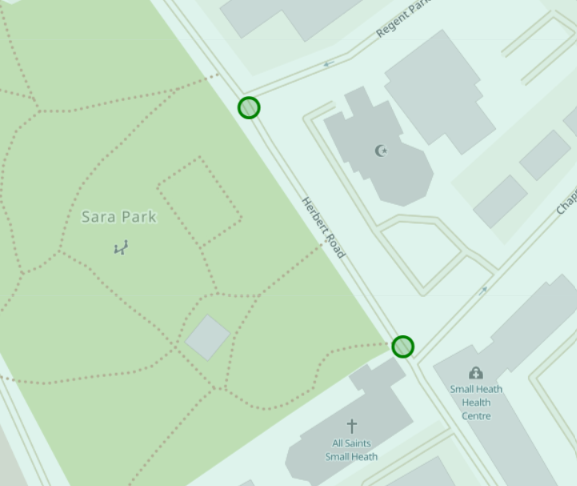
We do object to the introduction of marked parking bays where there is no housing behind them in this plan, for example, on Dixon Road. These should be double yellow lined to discourage parents driving their children to school.
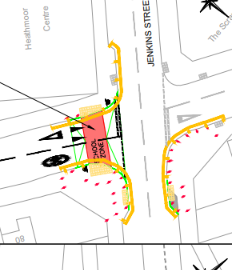
Finally, having reviewed images of the Camelot Way/Jenkins Street junction, we believe all four corners should have a bollard treatment to ensure safe pedestrian access, instead of only the two sides planned.
https://www.birminghambeheard.org.uk/bcc/ssj-thornton/
We are unable to support these proposals as we remain unconvinced that one way streets will make this school journey safer. The same amount of traffic will pass by the school, this time with no oncoming traffic to slow them down. Further, through traffic will not be restricted between Washwood Heath Road and Alum Rock Road, two extremely dangerous roads. Instead, modal filters should be installed at the Alum Rock Road end of Thornton and St Agatha’s roads, to eliminate through traffic past this school, and discourage parents from driving to the school to drop off their kids.
However, the intervention should not stop there. The journey to school does not start on the school street. This school is positioned between two of the most statistically dangerous roads in Birmingham, so further action needs to be taken. For starters, Woodwells Road/Alum Rock Road also needs a modal filter, as it is used as a cut through from Sladefield Road. This would protect the pedestrian journey to the school. If a modal filter will not be installed, the junction needs drastically narrowing with a raised crossing.
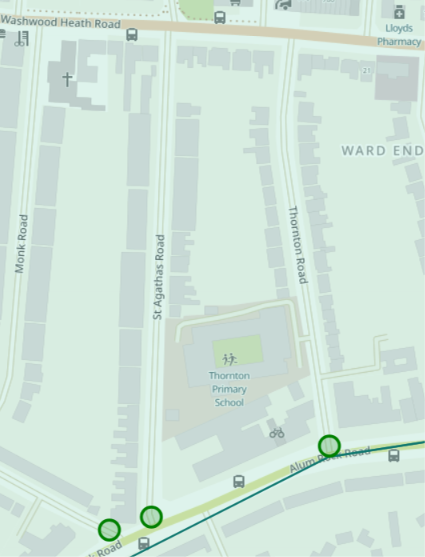
We would also like to see action taken to reduce the KSI hotspot of Treaford Lane and Alum Rock Road. This junction sits right by a zebra crossing that kids will be using to walk to school, so we would like to see a modal filter on Treaford Lane, at the junction with Cotterills Lane, to reduce the flow of traffic using this junction. We can see outdated, ineffective speed cushions on Treaford Lane, so there is clearly a problem that needs dealing with. A modal filter at the Cotterills Lane end would also reduce complexity at the double mini roundabout, and so improve safety there.
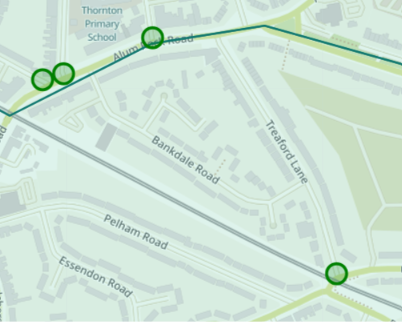
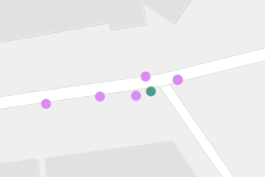
Finally, the zebra crossings that do exist on Alum Rock Road should be converted to raised zebra crossings, with curb buildouts to reduce crossing distances for pedestrians.
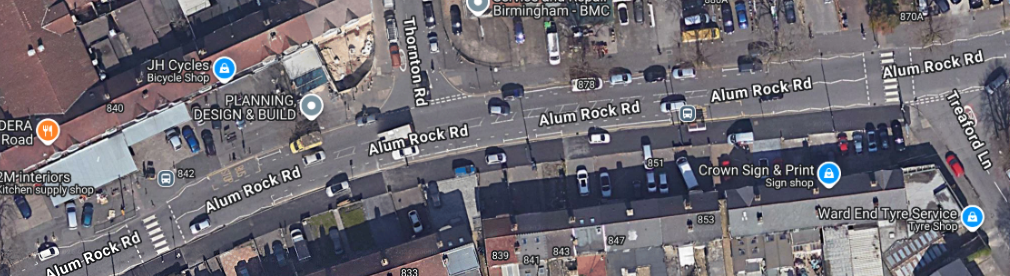
If the original plans are stuck to, then we would like to see the Thornton Road/Alum Rock Road junction narrowing as it is being converted to one way:
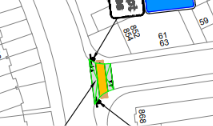
-
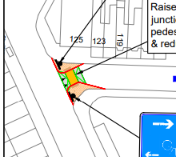
Judging by pictures on Google Maps, the St Agatha's/Alum Rock Road junction will also need a bollard treatment to ensure the pavement is used by pedestrians only.
https://www.birminghambeheard.org.uk/bcc/ssj-mayfield/
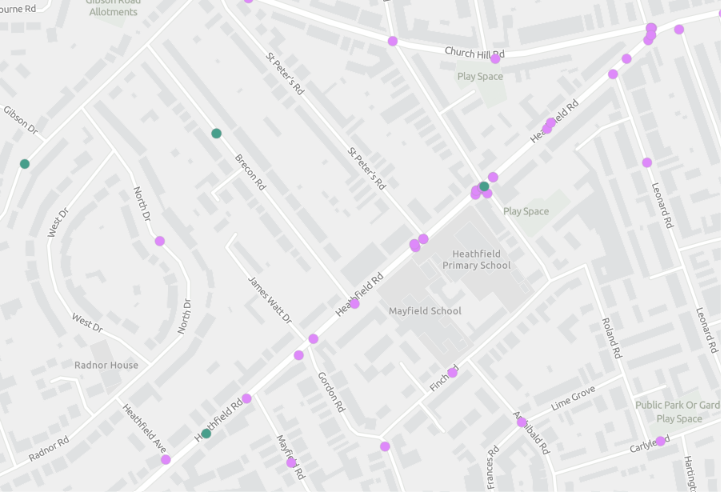
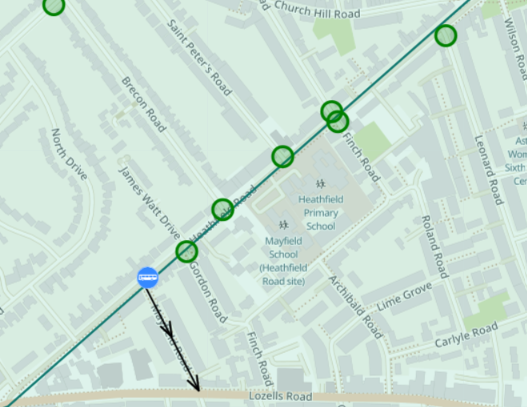
We cannot support these plans. Heathfield Road has a major issue with KSIs, with many slight and one serious injury outside the school in the past 5 years. It is an unclassified road, yet is clearly used as a rat run by general traffic attempting to avoid the designated B route, Lozells Road, to get to the A34. Adding double yellow lines and uncontrolled crossings, is not enough on this road, and will not tackle the root cause of why it is unsafe for kids.
Our plan would involve bus gating the road and adding side road modal filters, to completely eliminate through traffic, reduce speeding, and create an environment where kids can walk and cycle to school safely. We need hard infrastructure to protect our kids, not paint.
https://www.birminghambeheard.org.uk/bcc/ssj-anglesey/
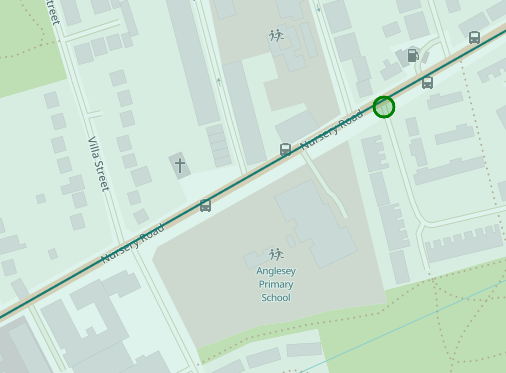
We do not oppose this scheme as the surrounding streets do not show evidence of high levels of KSIs, so other schools should be prioritised with the more ambitious schemes we have suggested. However, we have some constructive ideas on how the scheme could be further improved.
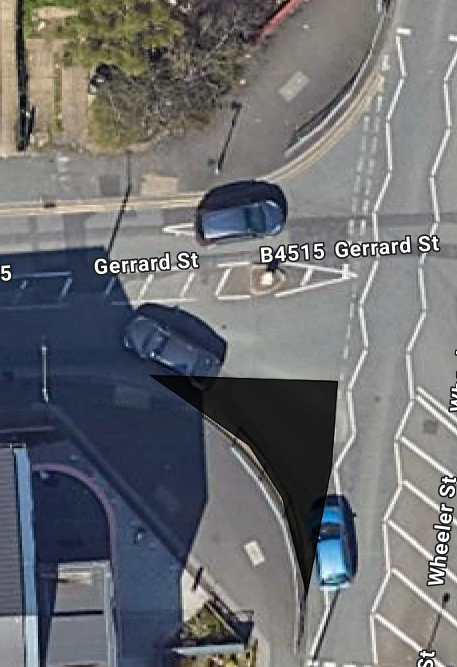
Firstly, as part of a rolling review of road classification, Nursery Road/Gerrard Street should be declassified as it runs parallel to the Lozells Road which can remain a B route. We would also like to see a modal filter installed on the Melbourne Avenue/Nursery Road junction, as this would remove complexity at the mini roundabout, and make the pedestrian journey to the school safer. Finally, we would like to see the Gerrard Street/Wheeler Street junction narrowed to slow cars as they enter the street.
https://www.birminghambeheard.org.uk/bcc/ssj-leaforest/
We support Option B of the consultation, as we believe removing through traffic to be the superior option to make a road safe. We ask that the kerbed closure has gaps left so that cyclists can continue through, as this would encourage cycling to school. Closing one branch of a junction also removes complexity so will make the area safer.
However, we do have some points we would like considered to improve this proposal. We are not convinced that double-kerbing is a good use of money. We would prefer to see the entirety of the roads that encircle the school have double-yellow lines. We are aware that this will require enforcement to make them effective, but there is no justification for parking on the school-side of the three streets bordering it, and double kerbing does not discourage parents from driving their kids to school.
We would also ask what the evidence is that making Hurstcroft Road one-way will improve access and safety. As stated above, our opposition to one way roads comes from evidence, and all we can see here is more space for drivers to speed past a school safe in the knowledge that no traffic will be coming the other way. We would ask that Hurstcroft Road is kept as two way running for this reason.
Https://www.birminghambeheard.org.uk/bcc/ssj-hallgreen/
Whilst we do not oppose this proposal, we believe this street could be made much safer, at less cost. We are disappointed to see dragon’s teeth road markings being proposed as an intervention, when we are in the midst of a Road Safety Emergency, where physical infrastructure should be prioritised.
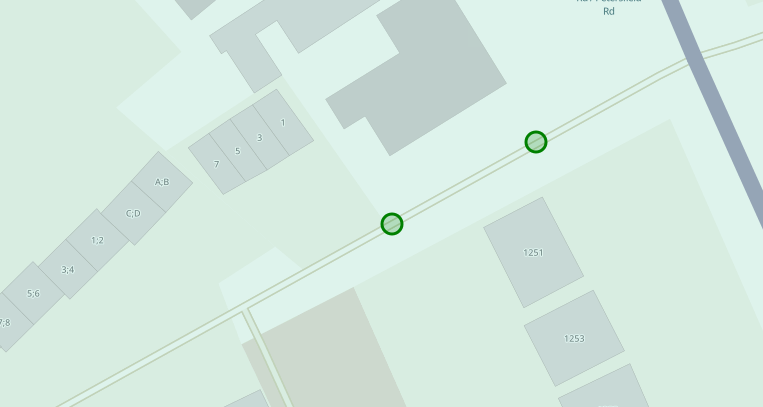
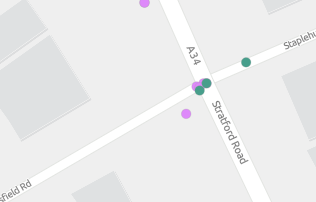
Instead of installing an expensive raised pedestrian crossing (which would cost more than £70k), we would pedestrianise the section of Petersfield Road where no access is required to properties, between HGC Club and Property No1. Two modal filters would cost less than £30k, and the money could go to fund more significant interventions elsewhere. Importantly, this would also make the street safer as traffic could not use it as a rat run between Stratford Road and Robin Hood Lane. Instead of trusting cars to stop at a zebra crossing, our plan would force them to. Indeed, the Petersfield Road/Stratford Road junction has a very poor KSI record, so reducing vehicle flow through here should be the priority.
https://www.birminghambeheard.org.uk/bcc/ssj-yorkmead/
We do not oppose these proposals, but they do not tackle the underlying problem causing road danger at this location. York Road is used as a rat run to cut through between the Stratford Road, and Fox Hollies Road. Clearly far too much traffic is using this road, as can be seen from the KSI hotspot near the school.
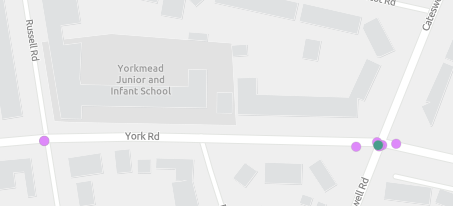
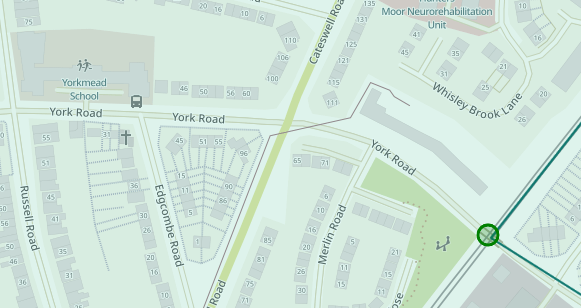
Therefore, to improve this scheme further, and in line with the city’s Road Harm Reduction Strategy, a modal filter should be introduced on York Road at the railway bridge, to stop through traffic. This will ultimately reduce the volume of traffic passing the school, making walking and cycling to it safer. Further modal filters should be investigated in the vicinity of the school to see if they would further improve safety, such as on Russell Road and Reddings Lane.
https://www.birminghambeheard.org.uk/bcc/ssj-robinhood/
We support this proposal, as we believe more ambitious measures should be prioritised at other schools in the consultation. Also, the bus route down Pitmaston Road means options are limited. Long term, we would argue for rerouting the bus onto Redstone Farm Road, so that a modal filter could be installed at the Pitmaston Road junction with Arkley Road. Child safety has to be a priority over bus routes.
https://www.birminghambeheard.org.uk/bcc/ssj-acocksgreen/
We do not support this scheme as it misses a golden opportunity to increase safety for kids walking to school around the Acocks Green Island, a KSI hotspot.
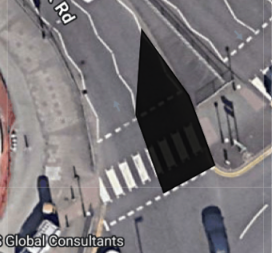
A review of KSIs at the island sees them mainly clustered around the only zebra crossing. All other roads leading from the island have traffic light crossings. It is not appropriate to ask kids to cross this stretch of road without the protection of a red light, and so we would advocate for conversion to a fully signalised pedestrian crossing here. If this is not in scope, then we should at least see the crossing narrowed so kids have shorter distances to cross the traffic.
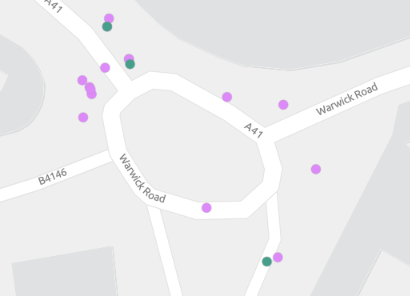
Long term, we would like to see this area simplified by filtering Westley Road and rerouting the 11 onto Olton Boulevard and Shirley Road. Combined with a modal filter at the Warwick Road end of Broad Road, the journey to the school would be significantly improved from the south and west directions. Beyond that, the roundabout could eventually be converted into a single phase traffic light junction which would free up lots of space for active travel modes in the area, as well as reducing congestion by joining up pedestrian sequences at all traffic lights.