Thoughts on the Priory and Edgbaston Road cycleway
On the recent 4-day Bank Holiday weekend, I planned to put together a long twitter thread on what problems I have with the A38 cycle lane, and how it can be improved.
I totally know how to have fun, amirite? ?
This somehow led to me looking through the plans for the cycle lane the council are currently installing on Priory Road, and I had to drop everything and write about them instead. Because they are so amazingly good!
I'm kidding.
I will first say that it's incredibly hard to critique plans without having any of the reasoning behind the design decisions. It would be a great move if Birmingham City Council did publish the reasoning behind each design, along with why other options were not pursued.
I therefore apologise if any of this seems harsh, but I can only go on the information I have available to me.
One reason why I've long been critical of the A38 lane, to which I've often been told not to complain because it's better than nothing, is that I was concerned that if the issues with it weren't pointed out to the council, then we would likely see newer schemes repeat those mistakes. Looking at this scheme, this is clearly what has happened, hence feeling the need to put these thoughts down even though the work on this scheme is nearing completion.
So, let's critique the new design.
The stated aim of the project is:
providing a cycleway connecting the A38 Bristol Road cycle route with the existing National Cycle Network Route 5 (NCN5) at Cannon Hill Park."
Which, no matter what my thoughts are on NCN 5 (tldr; not a fan), is an idea I can get behind. So far, so good. Now onto the designs themselves.
Section 1: Outside Cannon Hill Park
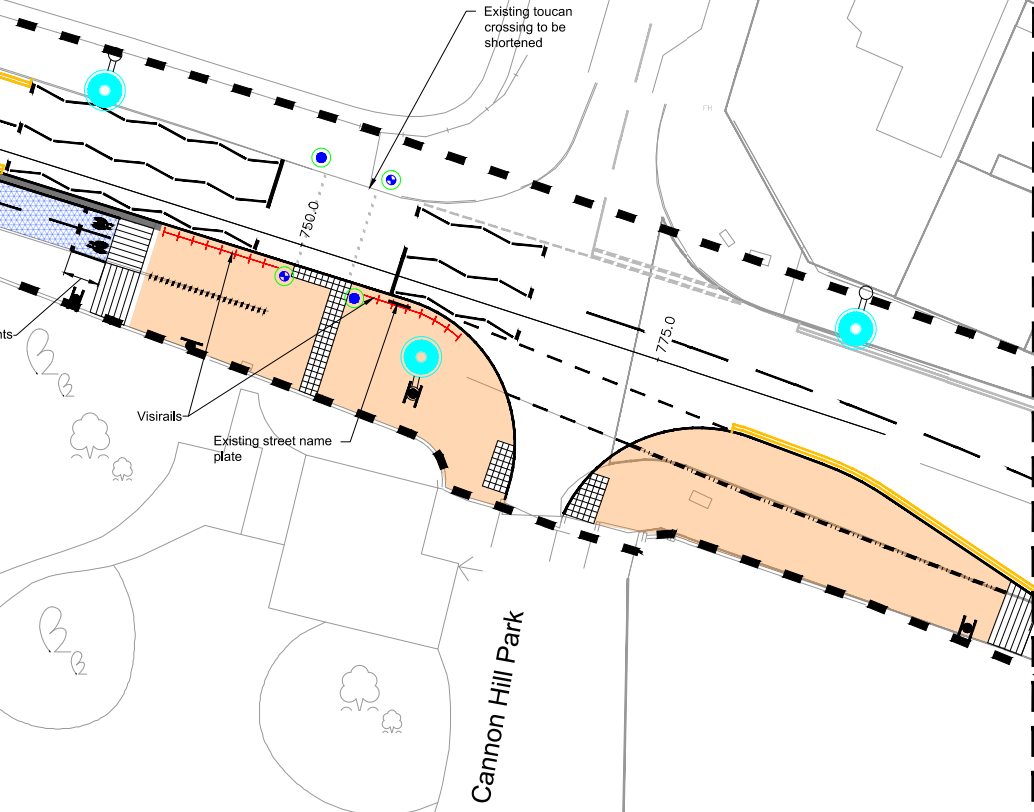
Whilst this is slightly counterintuitive, shall we start at Cannon Hill Park (p.5 of the PDF)?
No, seriously, why doesn't the lane start at Cannon Hill Park? Instead of 20m away.
I know that there is a proposed cycle lane from here to the Alcester Road in Moseley, but I don't understand why you wouldn't make the entrance to Cannon Hill Park the place where the two schemes join up. Especially as that scheme seems to currently be in limbo.
It instead starts with a shared path.
As you may know (if you follow me on Twitter), I do not believe that shared infrastructure is cycling infrastructure. It's unpleasant for both people on foot and on bike. It's basically lose/lose.
More importantly, LTN 1/20 seems to agree with me. If you don't know, LTN 1/20 is the official design guide for cycling infrastructure, which I have to say is a fantastic document, chock-full of great design principles for cycling infrastructure.
I would hope that every employee of every Highway department in the country would receive formal training on it.
Frankly, every councillor should at the very least read it.
On page 8 of it, in the section marked Core Design Principles, there is this example of bad design:
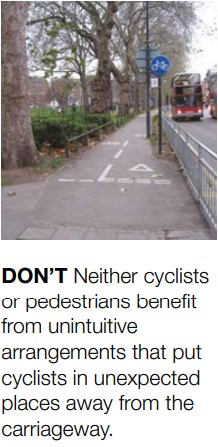
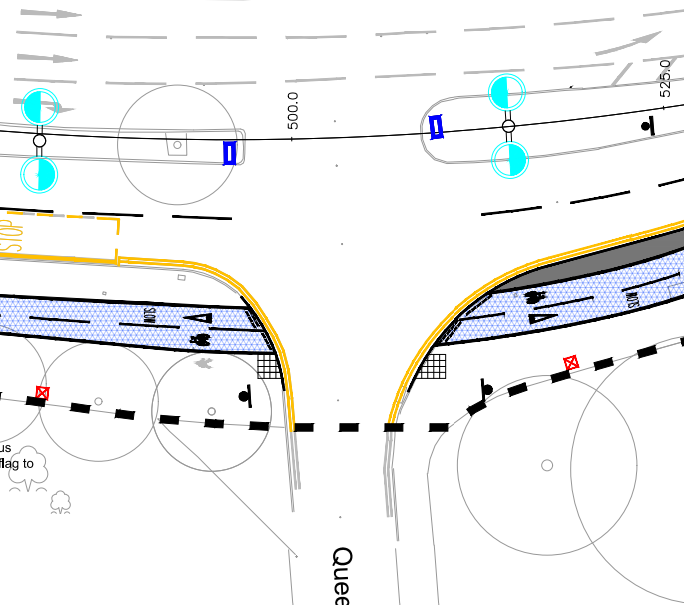
Here we see that the path stops, in deference to the entrance of a car park.
That's right, a car park.
Why doesn't the cycle lane have priority here?
Furthermore, why hasn't the junction been narrowed? They're asking people crossing the junction on foot and on bike to look out for cars that the junction has been designed to not slow down when turning into it.
Surely, there has to be a better way to design this junction.
Helpfully, we have the luxury of looking at the LTN 1/20 again. And, again, in the core design principles, we have this example:
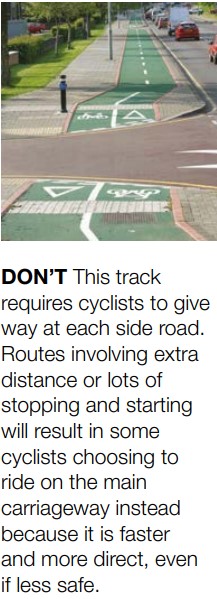
10.4.11 A cycle route crossing a lightly trafficked street may be given priority over traffic on the carriageway by using give-way markings to TSRGD diagram 1003. The cycle track crossing should be placed on a hump"
p. 101, LTN 1/20This is described as a Cycle Priority Crossing (CPC). To me, this junction is a lightly trafficked street, so fits the criteria to be a CPC, and could also have a continuous footway to benefit pedestrians.
Whilst I was finishing this post up, Chris Brammeier provided this update on Twitter:
The response was that the Road Safety Audit concluded there was a risk of rear shunts so it wasn't put in (big disappointment) Think it's more of a case of RSA methodology not keeping up with more modern design ethos in LTN1/20."
Taking this explanation at face value, the road only has a second lane added in the 50 metres prior to this side road, so couldn't that lane be for left turning traffic only, therefore reducing the risk of rear shunts?
Section 3a: Junction with The Ashes
Onto section 3a (p.3). 3a, because this part is so disappointing that it needs splitting in two:
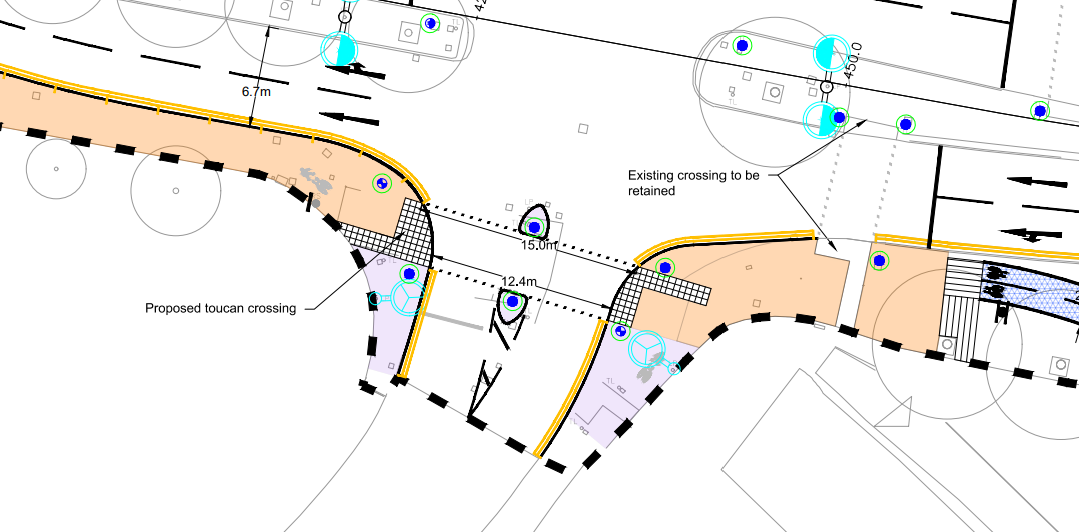
Firstly, the lane just ends, turning into a shared pathway again. Why?
If I had to guess (from what happens on the A38 cycle lane), it seems that whenever there's some form of pedestrian crossing on the road, the decision has been made to make the paving around it a shared route. I can't say that I agree with this as a design decision. I am perfectly happy with the idea that cyclists need to look out for pedestrians (as the recent update to the Highway Code made official), but not giving pedestrians any clue that it is a shared path is a mistake.
To be fair, the junction is being narrowed here (I'd missed that on my initial viewing of the plan, but Google Maps Streetview shows that they've been narrowing it).
To cross The Ashes, however, there is a Toucan Crossing. Whilst there is no indication of the proposed phasing of the traffic lights here, from the required vehicle movements I assume that the phasing will be along these lines:
- Green for cars on Edgbaston Road (both directions).
- Green for cyclists and pedestrians on Edgbaston Road.
- Green for cars turning into The Ashes from the Moseley-bound carriageway of Edgbaston Road.
- Green for cars coming out of The Ashes.
So, that's three out of four phases are red for the cycle lane, suggesting a lot of waiting time for cyclists. They could, of course, have extra green phases for cyclists and pedestrians, which would be better.
I'll be honest, I'm not sure what the best way of designing this junction is. I don't know if you could have a CPC here, with cycle lane traffic controlled on the same lights phases as the Edgbaston Road. This would mean that cars turning into The Ashes would be expected to give way to traffic on the cycle lane. The left lane on Edgbaston Road could again be for left turns only, to prevent rear shunts if a vehicle has to stop to allow cycles to pass.
Alternatively, and this is probably the better solution, the left lane on Edgbaston Road could again be for left turns only, and the lights phasing could be that this lane is red when going straight along the Edgbaston Road is green, allowing cyclists and pedestrians to cross The Ashes at that point. This lane could then be green when vehicles are allowed out of The Ashes.
So, whilst it's a complicated junction, it's not a great start to this section.
Section 3b: Crossing Edgbaston Road
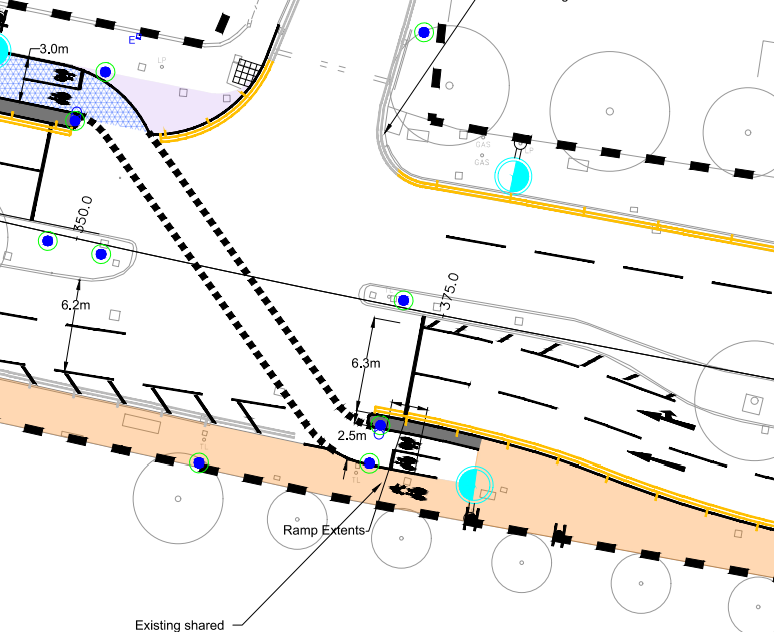
More shared pathway. And then the cycle lane crosses TO THE OTHER SIDE OF THE ROAD!
I genuinely don't know why the lane is on one side of the road for half of it, and swaps for the other half. I presume that there's a good reason for this design decision, but I have no idea what that reason might be.
So, why is this a bad design? For starters, if we turn to our new friend, LTN 1/20, it is very specific about making cycling infrastructure as direct a route as possible:
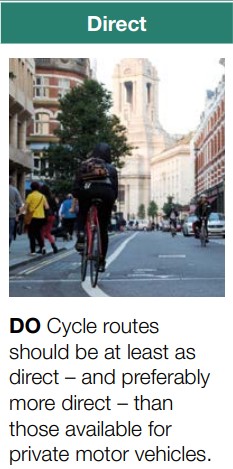
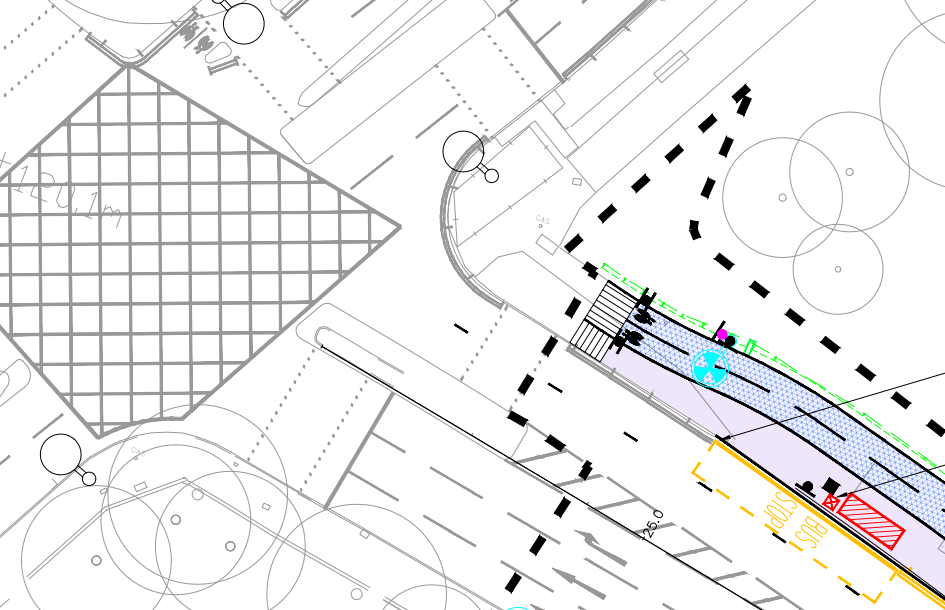
What's that, you say? Why doesn't the lane actually join up with the A38 cycle lane? I HAVE NO IDEA!
The project to connect the A38 cycle lane to Cannon Hill Park, doesn't actually connect at either end. This is the most inexplicable decision taken here. At least the connection to Cannon Hill Park is included in another project, as strange as that decision is. If there's yet another project to connect this to the A38 cycle lane, I'm not aware of it, though I wouldn't be able to understand why it wasn't just included in this project.
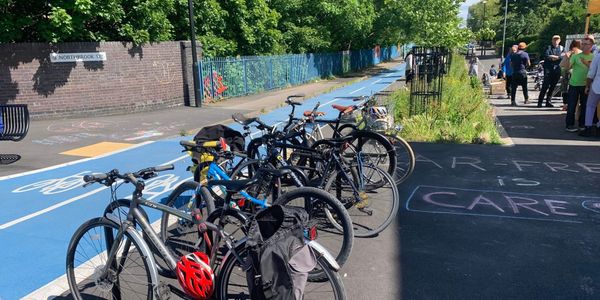
On a positive note, I will say that I do like how they have the lane completely away from the bus stop. I am very much not a fan of the way the lane weaves around bus stops on the A38 cycle lanes, so this is progress.
Conclusions
I think it's fair to say that I think there are a lot of flaws with the design of this scheme. Worryingly, some are flaws that the A38 cycleway also has, which suggests that Highways Department have baked in some poor design choices.
Importantly, I believe these are flaws that will hinder the cycleway from fulfilling its maximum potential.
How would I fix this scheme? Well, in the words of the immortal phrase, I wouldn't start from here! However, given that the work is nearly complete, I feel these steps would massively improve the cycleway:
- Keep the lane on the left-hand side all the way to the A38.
- Make the junction with the MAC a Cycle Priority Crossing.
- Add a left-turn only lane to turn into The Ashes and synchronise cycleway traffic with the flow on Edgbaston Road.
- Do not have any sections of shared paths. If that requires coming up with a design for how cycle lanes interact with pedestrian crossings, then that can only benefit every single scheme designed from this point forward.
- Join this section up to the A38 cycle lane. Not using a pedestrian crossing, but with its own crossing.
I strongly believe that lessons need to be learned from each development, and there is, sadly, little visible sign that this is happening.
I don't know if Birmingham City Council have had any contact with Active Travel England, who's head, Chris Boardman, has said that they are happy to help with designs:
It is an inspectorate, but the main thing we can do is help. If an authority hasn’t even got an outline design, we can help them with one – even do it for them."
Anyone who has got the courage but hasn’t got the resources, we can instantly add value. If a council says ‘we haven’t got room for a scheme’, we’ve got the country’s leading experts who can say ‘you could do it this way’. We’re coming with bags of solutions."
Chris Boardman interview in The Guardian
I don't mean this to be critical of Birmingham City Council. I love the sentiment behind the Birmingham Trasport Plan, it's an admirably bold document. However, the plan to encourage people out of cars and onto bikes, trikes, and scooters won't work if the cycle lanes don't work. And, sad as I am to say it, the cycle lanes produced so far don't meet the standards required to really boost usage. Therefore, I do think that the Council could benefit from talking to Active Travel England.
Hopefully, you'll find this critique of the new Edgbaston/Priory Road cycle lane useful/interesting, and if it can contribute towards improving cycle lane design in Birmingham, then that would be a bonus.